
Dawson County Supervision Types
Parole is conditional release from a Texas Department of Criminal Justice prison before the sentence ends. The Texas Board of Pardons and Paroles makes the release decision, and the TDCJ Parole Division manages supervision. Mandatory supervision is another form of release for legally eligible cases. It is not the same as parole, and for eligible cases tied to later offense dates it may still require a discretionary Board decision. Full discharge means the prison sentence and its supervision term have ended.
Probation, formally called community supervision in Texas, is imposed by a court. A Dawson County judge may order it as part of a judgment or after another court event. It is administered through the serving Community Supervision and Corrections Department, not through the state parole office merely because the person lives in Dawson County. The signed judgment and community-supervision order are the best starting records.
| Point | Parole | Probation |
|---|---|---|
| Source | Release from TDCJ confinement by state law and Board action | Order entered by the criminal court |
| Supervising system | TDCJ Parole Division | Local CSCD serving the court |
| Core record | TDCJ and Board status or release record | Judgment and community-supervision order |
| End point | Parole discharge or sentence expiration | Court termination or discharge order |
- Discharge
- The legal end of the sentence or supervision term.
- Absconder
- A supervised person alleged to have stopped reporting or left supervision without authorization.
- Detainer
- A request by another authority to hold or receive a person.
- Revocation
- A formal process that may end supervision after a proven violation.
Check Dawson County Supervision
Texas has no single public name search that permanently lists every parolee and probationer. Verification therefore depends on custody type and the record date. A TDCJ result can show parole review or release information while a person remains in state prison, but the public inmate search is limited to current TDCJ custody. It should not be treated as a lasting former-prisoner index.
- Collect the full name and, when available, the TDCJ number, SID, cause number, or Dawson County booking number.
- For a state-prison case, check the TDCJ Inmate Information Search while the person remains incarcerated. Record the status and check date.
- Before a parole vote, call the Board status line at 844-512-0461. After a favorable vote, call the Parole Division release-status line at 512-406-5202. A vote does not prove physical release.
- For probation, ask the Dawson County clerk handling the case for the signed judgment, community-supervision order, and any later revocation, termination, or discharge order.
- Confirm the office assignment through the responsible parole office or CSCD. Residence, placement, and reporting instructions can change.
The Dawson County released-inmate search paths help identify whether the last custody was the county jail or TDCJ. That distinction controls which supervision source can answer the question. A county bond release does not by itself establish probation, and a favorable parole vote does not establish that the person passed through the prison gate.
Dawson County Parole Office Route
The official TDCJ county assignment index routes Dawson County to the Midland District Parole Office in Region V. This is the correct geographic starting point for a person released from TDCJ and placed in Dawson County. It does not prove the person’s current address, personal reporting site, or assigned officer.
Midland District Parole Office3900 E. Highway 158
Midland, TX 79706
Phone: 432-684-4590
Fax: 432-684-6947
Hours: not stated in the research source
The Region V office directory supplies the contact details. Call before traveling and provide an identifying number when the office requests one. The office can explain routing, but public disclosure limits may restrict personal supervision details.
The image below comes from the official county-to-office index.
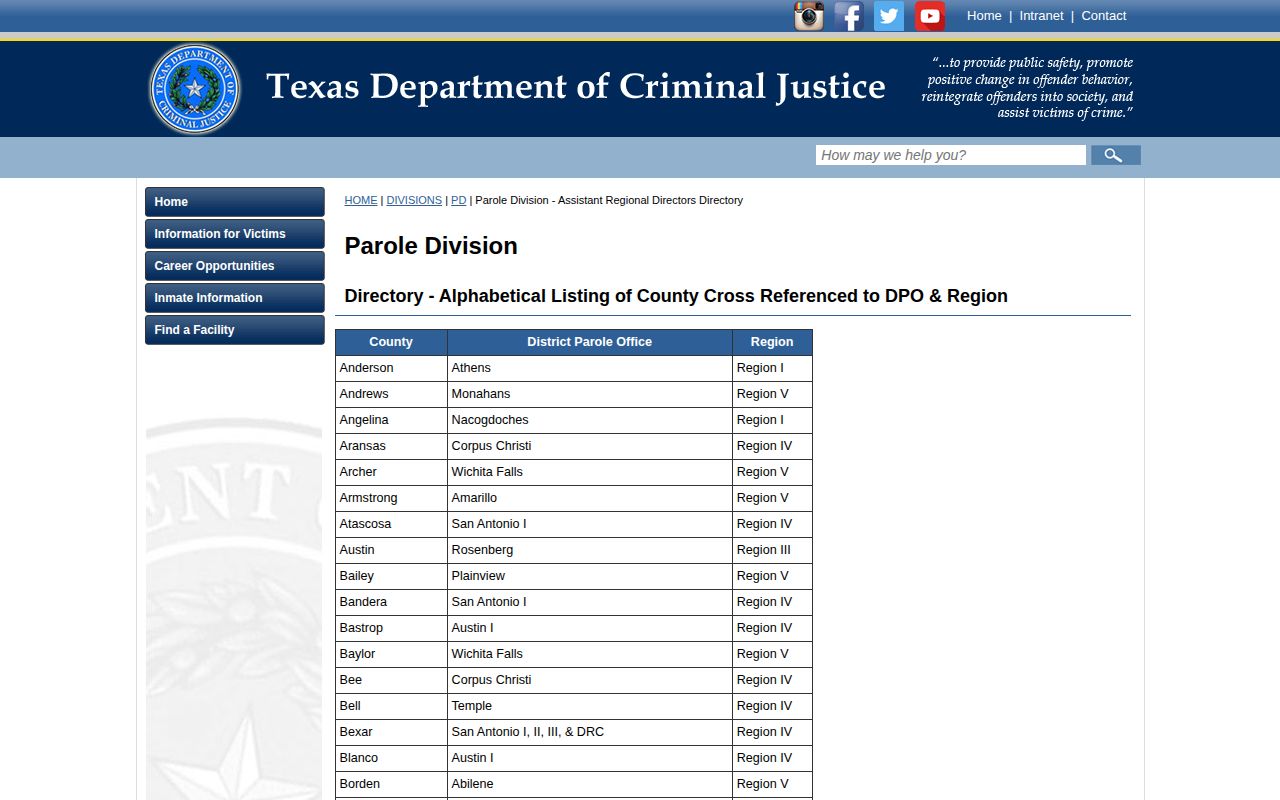
It documents the Dawson-to-Midland route and helps prevent a mistaken search for a state parole office in Lamesa.
Dawson County Probation Records
Local probation remains separate from the Midland parole assignment. For a felony case, begin with the Dawson County District Clerk. For a county-level misdemeanor, begin with the County Clerk. Ask for the cause-number docket and the signed order, since a brief docket label may not state the full term, conditions, or disposition.
An official county construction document identifies a combined Adult Probation and Juvenile Probation renovation at 411 S. First Street in Lamesa. The source does not establish that the move was completed, that a public counter now operates there, or what its current hours and telephone number are. Confirm the serving CSCD and visit details through the courthouse before going to that address.
Probation can follow a plea or judgment without any TDCJ release. Conversely, leaving Dawson County Jail on bond does not prove probation began. The court file supplies the legal authority, while the sheriff’s release transaction supplies the physical exit time.
Dawson County Violation Status
Supervision conditions vary by order and case. Common high-level duties can include reporting, obtaining approval for travel, attending directed programs, and obeying court or release rules. Only the actual order and supervising authority can state the conditions for one person. A missed appointment or allegation should not be recast as a final violation finding.
The TDCJ Parole Division Command Center processes violation reports, monitoring alerts, and warrants through law-enforcement systems. Those systems are not a public statewide absconder search. No verified public Dawson County absconder list was found. Confirm an alleged warrant with Parole Division or law enforcement rather than relying on an old private listing.
A revocation hearing concerns alleged violations after release and differs from ordinary parole review. Current custody information may appear through VINE Inmate Check when a participating agency reports it, but an alert is not the warrant or revocation record.
Ordinary Texas parole decisions also do not use a formal public hearing calendar for each named prisoner. Board panel members review and vote on case files. A later revocation proceeding is a different process. Keeping those stages separate prevents a review date, favorable vote, or alleged violation from being reported as a completed Dawson County release or a final loss of supervision.
Dawson County Release Preparation
Preston E. Smith Unit is a TDCJ prison physically located in Dawson County. Its official unit directory lists CHANGES/Pre-Release and Reentry Planning among its programs. Those entries establish a state-prison preparation layer in Lamesa, although the research found no county-run reentry center.
Program listings are navigational facts, not a promise of enrollment, a particular placement, or a benefit after release. A person leaving Smith Unit may enter parole or mandatory supervision, transfer to another TDCJ unit, or reach full discharge. Use TDCJ status records to distinguish those outcomes. The Dawson County Jail follows a separate local track.
Release planning also does not identify the assigned supervising office by itself. The county index routes Dawson placements toward Midland, subject to the person’s real placement and TDCJ assignment.
Dawson County Parole Status Records
A parole review result is one point in a longer process. The Parole Division identifies cases before eligibility, an Institutional Parole Officer prepares a summary, and a three-member Board panel votes in sequence. Two matching votes settle the result. A denial includes a later review date, while approval can carry conditions that must be completed before release processing ends.
The Board does not hold an ordinary formal public hearing for each parole or mandatory-supervision decision. Public Board meetings should not be treated as one person’s release calendar. The official parole review process explains the file-based route, and the review-results service supplies the decision stage. This matters for a Smith Unit case, where a projected date and Board result can exist before anyone physically leaves state custody.
Write down the exact decision code and stated conditions. Do not translate every favorable code as released. Placement, treatment prerequisites, detainers, later information, or rescission may still affect the result. If the person is incarcerated, compare the decision with the current TDCJ record. After a favorable vote, the release-status line is the proper next channel.
Dawson County Supervision Proof
For parole, useful records include the TDCJ number, Board decision, release type, release date, supervision status, assigned office when available, and eventual discharge date. Texas Government Code Section 552.029 makes specified basic TDCJ facts public despite broader inmate-record confidentiality. A focused request is more reliable than asking for an entire institutional file.
For probation, ask the clerk for the judgment and specific community-supervision order. Later documents may modify conditions, extend the term, revoke supervision, or discharge it. Court shorthand can omit that detail. Use the signed instrument and cause number, then confirm current administration with the serving CSCD.
Dawson County Supervision Discharge
Release and discharge mark different points. A parolee has left confinement but continues serving the sentence under supervision. A probationer remains under a court order. Discharge occurs when the governing authority records that the term has ended, unless another independent legal obligation remains.
For parole, request the TDCJ or Parole Division record that states release type, supervision status, and discharge or sentence-expiration date. Texas Government Code Chapter 508 governs parole and mandatory supervision. For probation, request the court’s termination or discharge order. Do not infer discharge from an absent web result.
The Board review-results route can clarify a decision while a case is in review. The official telephone information is shown in the captured source below.
Keep copies of the source response and note when it was obtained. A current supervision answer can change after a later discharge, revocation, transfer, or amended court order. When records conflict, compare their dates and ask the agency that created the newest record to explain the status. This preserves the difference between release from a facility, supervision in the community, and final completion of the sentence.
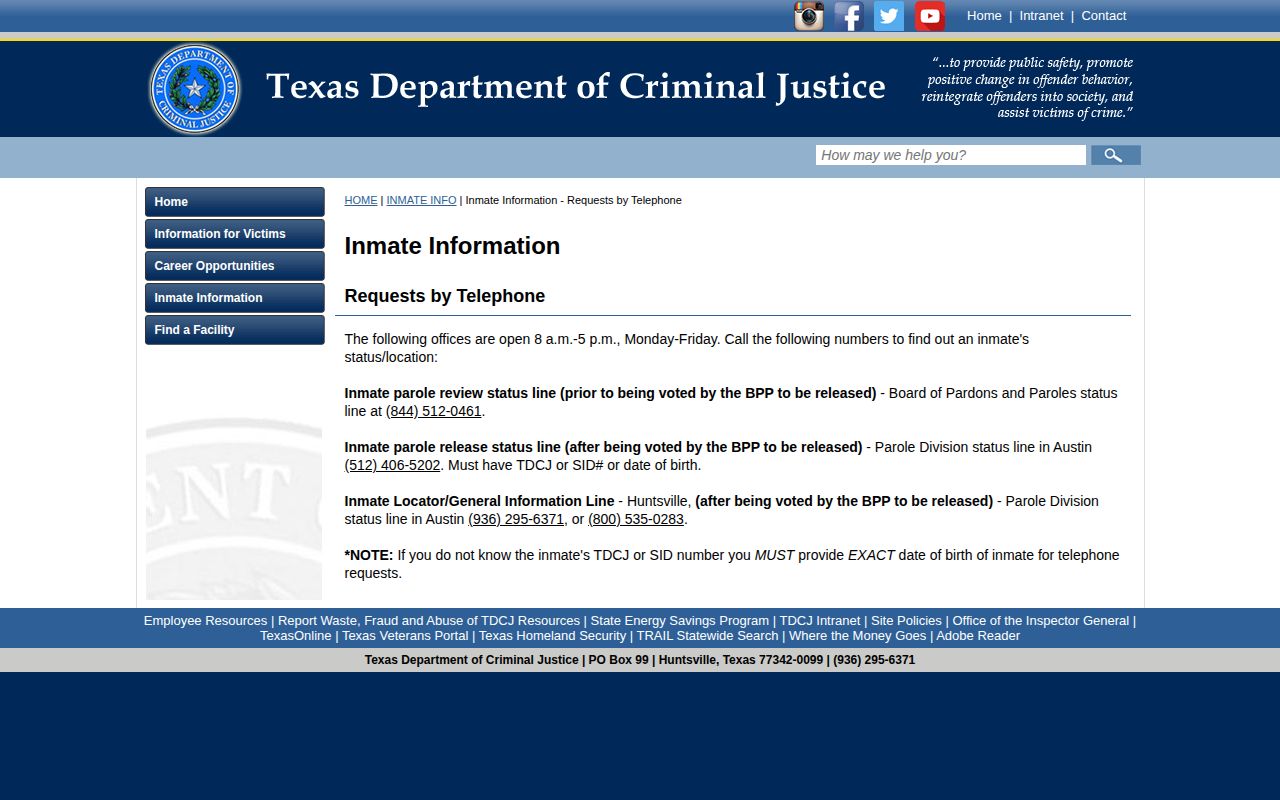
Those lines separate pre-vote status from post-favorable-vote release processing, which keeps a decision from being mistaken for actual release or final discharge.